What is it about nice people that attract total idiots?Nice people are martyrs. Idiots are evangelists.

SOCK IT TO ME BABY!!!
Showing posts with label japan. Show all posts

Monday, July 2, 2012

Updates and pics

I thought I'd update a couple of news stories from the past.  But first, My first actual interview- such as it is- is with an inventory-taking outfit the day after the 4th (commonly known in other countries as the fifth).  In preparation of this, I have eliminated half of my non-jean slacks as no longer making the full orbit around Planet Stomach, and will have to go out later and get black shoes that aren't best left for ballroom dancing.  Also, I have become sufficiently versed in what "business-casual" is  (thus the five pairs of slacks that have become "business casualties").

Also, planning goes apace for Laurie's big 4th-o-July blowout; unfortunately, at this point our experience with the Rug Doctor could use the same pic for "before" and "after".  I guess in our case, "Steamin' mad at dirt" was more like "mildly miffed".  I'm thinking we could pass out a pamphlet explaining "small dark stains" as "spill targeting areas" and hope for the best.


Okay, anyway, here are those updates.  Remember the Chinese-Korean guy that raped, tortured, and dissected the girl while the Suwon PD tried desperately to hide the fact the lost their heads up their butts?  He got sentenced the other day:

Wu Yuanchun was sentenced to death, followed by orders to wear electronic anklets for 30 years and his personal information to be known for 10 years. Even though he was sentenced to death, South Korea has not carried out the death penalty since 1997. The electronic anklets are just in case his sentence is commuted, which is highly likely.

The court looked at several things which influenced their decision:

1) All his testimonies turned out to be lies, he was never truthful from the beginning, refused to answer many of the questions leading to suspicion that he refuses to come clean. 
(You don't say?)

2) He was remorseless, did not show any regret.

3) The body was carefully cut up into hundreds of pieces with a kitchen knife and carefully preserved in their own bags (like how you cut up a large chunk of beef to preserve it in freezer). He did not use a saw which he could have used, he used a kitchen knife. Leading to suspicion that his goal was to preserve the meat for sale or consumption.

4) The victim's organs were also carefully cut out and preserved in ice packs, leading to suspicion that his goal was to sell the organs to unknown underground trade, with many people pointing fingers at China's flourishing illegal organ trade.
(Another good reasons the Koreans don't like the Chinese...) The court acknowledges that this is a possibility.

The Korean civic groups are not satisfied with the investigation, and they are rallying to urge the police to reinvestigate the case for possible other murders committed by this person, and a possible flourishing trade in human flesh and organ in Korea's Joseonjok communities and China. They point out the recent smugglings of human flesh pills from China which made big headlines, and they say there is a link there that needs to be investigated. They also point out that Wu's skills at knife work and his cool and calm way of slicing up the victim's body suggest that he has done this before many times.
Human flesh pills?  Read on:
SEOUL: South Korean customs said it had confiscated more than 17,000 health capsules smuggled from China that contain human flesh, most likely extracted from aborted foetuses or stillborn babies.
The Chinese Ministry of Health said it had been investigating allegations that capsules were being manufactured from human remains but had found no evidence.
The South Korean customs agency said pills had been smuggled into the country through parcels and luggage carried from China. The pills were composed of ''ground stillborn foetus or babies that had been cut into small pieces and dried in gas ranges for two days, then made into powders and encapsulated'', the report said.


Among some traditional healers in South Korea and China, unborn infants, and particularly placenta, are believed to have medicinal properties.
''Human flesh pills are similar to a bizarre invigorate-seeking culture where people search for items such as seal's genitals and bear gall bladder in hopes for boosting one's stamina,'' Dr Ha Il-hyun at Seoul's Konkuk University Hospital told the newspaper Chosun Ilbo. ''If there's anyone who claims he benefited from the pill, it would only be a placebo effect.''


I really can't add anything to that.  Every culture has its things that seem odd or weird.  I praise God I was not born into one that believes in THAT.

Moving on....

Remember the Rikuzen Takata "miracle tree", the only one that survived the tsunami?  When I checked in the spring, I thought they were declaring it lost.  Apparently not...

A single pine tree that survived after an entire forest in the city of Rikuzentakata was swept away by last year’s tsunami is now dying due to severe damage from the disaster. But the local authorities are seeking funds to save it.
The so-called “miracle pine” is the only survivor among some 70,000 pines which were taken away by the tsunami on March 11, 2011.
The local government will now open a Facebook page to ask for donations to preserve the tree. According to the authorities, the project may require Y90 million ($1.1 million). It would provide the tree with an antiseptic treatment.
Rikuzentakata is still trying to recover more than one year after the disaster. The surviving tree is now seen by the local community as a symbol for resilience in a city where about 1,500 people were killed last year by a tsunami wave of up to ten metres.

My understanding is that they will open the Facebook page on interview day (weren't you paying attention?  July 5th).  I'll try to remember to check on that.


And now, this morning's pics.  Remember the buck who grabbed his buddy and split the other day?  This time they decided to play tag with us all over the woods.


Later on, I told a jogger headed that way where to watch.  He must have run into them, because about 5 minutes later they came tearing across the south end of the woods as we were on the ravine trail.
 

Friday, August 5, 2011

Rikuzen Takata update #7

I was hoping to do this last weekend, but a plea for info from a certain reporter has thus far fell on deaf ears.  One thing that has framed the entire concept of recovery for Rikuzen and nearby towns is that the area is over 2/3 65 years old and up, and was in a steady decline even before the disaster.  And much of the heart of the city's youth fell in the tsunami- I just saw a report that when the harbor's tsunami gates failed to close, 45 young firemen gave their lives trying to shut them manually.

And the courage needed to live on is just as great.  As the weather warmed, flies bred in the still-unremoved debris, nearly swamping the town again.  Eradication measures by the government had soon cut the fly population by 90%, according to one resident, but it still had him catching 100 flies a night in three traps.  The Japan Pest Control Assn. sent in a crew of 4,000 to assist.  They decided to assess the size of the problems by setting traps at various locations in each city and checking them at 20-minute intervals.  In Rikuzen's Osabe district, they were totalling 300 per count.  Some other cities were registering as many as 2,800 catches, and the 20 garbage pickup sites in nearby Kamaishi were catching 22 lbs. of flies per week.

Another problem as the weather changed is that the bulk of clothes donated to relief agencies were winter items such as heavy coats- great when the quake hit in March, not so good now.

The age demographic there has also caused a crisis in care for the elderly.  Many have relatives in various states of dementia, aggravated by the conditions.  To care for them in the temporary homes most people who have homes live in is near-impossible; the government lifted capacity restrictions on care centers such as hospitals for the emergency, but many are worried over what they'll do when the government re-instates the regulations.

Heroes arise to try to bring life back to a semblance of normalcy.  One is Akishi Sasaki, coach of Takata High School's baseball team.  The school building is gone, the ball field a relief camp.  The kids journey to Ofunato to learn in a once abandoned school; the players practice wherever, and play where they find open diamonds.  In July, the team competed in the national tournament's first round.  Many from the city followed them.  Most of the boys had lost homes;  none were killed, but a star pitcher had to move out of the area to live with relatives.  A picture of him took his place on the bench as the team lost a lead and the game, 5-2.  Afterwards, the man who'd held them together talked to them.On the grass outside the stadium, Mr. Sasaki, the coach, gathered his players. "Without a doubt, you guys will build the future of Takata," he told them. "You've experienced a lot. But you've come out stronger."

Another hero is Masaru Kumagai.  Once the curator of the Sea and Shell Museum, he is now the de facto curator of the main municipal museum, which lost much of its collection and all of its staff in the wave (including his own mentor, Masahiko Sato).  Bit by bit the trained archaeologist has led his volunteers in recovering items from the muck and debris, including a set of 1,200 year old sword blades.


Also among the finds are the Yoshida diaries, documents from the shogunate period dating back hundreds of years and severely damaged by the water.  He realizes that rebuilding the museum will cost millions of Yen and is probably out of reach.  But Kumagai was "raised by the museum," and lives it every day.

Yet another is 66 year old Mitsuaki Kinno.  A volunteer, he runs the public bathhouse that has become an essential public meeting place.  At its height when everyone was homeless, the baths (known as Fukko no Yu, or "a bath for recovery") served 300 people a day; now that there are some with at least temporary housing it runs about 1/3 of that.  Still, it is so popular- and necessary from a societal perspective- that a planned shut down date of late July was cancelled.  While Kinno doesn't know how much longer he'll be able to do the exhausting job, he has no intention to give up while it- and he- is needed. 

Hope, though, goes on.  The Singapore Red Cross announced  in a report dated today that they had raised S$ 34.4 million ($28.2 million USD), of which S$11 million (just over 9 mill American) will go to building a hall/evacuee center in Rikuzen.  But the real battle is if the young people like coach Sasaki's team will actually stay to do the job, or if the exodus from the aging northeast of Japan will accelerate.

Much like the heroic efforts to save that one remaining tree, it remains to be seen if even heroic efforts can succeed.  For the tree, we might know as soon as next spring if any of the desperate measures tried will end up saving the tree.  For the city itself, the results are going to be much more long term.

Wednesday, June 22, 2011

Rikuzen Takata update #6

Here are some notes from the town we've been following since what is being called the Great East Japan Earthquake of 2011.

A recent law passed by the embattled government of Prime Minister Kan allows the government to lease commercial space for free to hard hit businesses trying to recover.  The caveat is that each municipality is supposed to find the vacant parcels eligible, and many of them do not have the wherewithal for the search.  In Rikuzen, applicants were told that the government would lease for free, but the business owners would have to find the lots, since they were having enough problems finding unowned land on which to build the hundreds of temp houses needed.  They added an additional caveat of each lot must be shared by two businesses.  As of last month, 21 applicants had found lots, while others were growing frustrated, wondering how to do a search job the government was incapable of.

That same government just defeated another no confidence vote three weeks ago.  Discontent over the lack of action and Kan's unfulfilled promises is growing.

Black tailed gulls have begun to make their nests in the still-piled debris, afraid of their old seaside nesting areas.  Many residents are looking at this as a sign of encouragement- the birds keep on going, so must we.

Rikuzen is on of six towns in the area unable to provide school lunches.  27 more out of 69 in the area are only providing bread and milk, and malnutrition is becoming a growing concern.

In nearby and hard hit Sendai, the Tohoku Rakuten major league baseball team, which delayed its opener by two weeks due to stadium damage, will bring a ray of hope to their city with one of the JPB's three all-star games coming to Sendai on July 24th.

Design exec Kazuyoshi Kurosawa and former resident based in Germany Koshi Tagaki are volunteering time to comfort the survivors of the disaster by doing oil paintings of lost family members from photographs given them by the victim's relatives.  The portraits seem to be taking a little of the sting of the loss from some of the mourners.

Finally, 100 graft sprigs were taken from the roots of that lone surviving tree in the nearby forest and grafted to rootstocks by the Forest Service's Tohoku Regional Breeding Office in Takizawamura, some 60 mi. NW.  Four of these sprigs are now thriving, and once they are stronger and the area is safe, all but one of them will be returned to their original home to begin the rebuilding of the forest.  The time of season was against all but the four hardy survivors, but due to the danger from erosion and salt water their progenitor was in, the botanists felt they had to move fast before the lone tree died and its dna was lost forever.

Thursday, March 24, 2011

Rikuzen Takata update #4

Sometimes, it's not that you died, but HOW you died.

RIKUZEN-TAKATA, Iwate - An administrator at a hospital destroyed by the March 11 tsunami gave his life to protect a precious lifeline--a satellite phone that was doctors' only link to the outside world after the disaster.
Sixty-year-old Shigeru Yokosawa was scheduled to retire at the end of the month, but he died in the tsunami that consumed Takata Hospital in Rikuzen-Takata.
Since that tragic day, the hospital's staff has continued to work in a makeshift clinic, using the satellite phone to communicate with rescuers and aid workers. Land lines and cell phones in the city were out of service after the disaster, making the satellite phone the only way to request medication and call for help with patients needing emergency care.
Just after the main tremor hit, more than 100 people--hospital staff, patients and local residents who had come seeking shelter--were in the four-story concrete building. Minutes later, people started shouting a huge tsunami was approaching.

According to Kaname Tomioka, a 49-year-old hospital administrator, he was on the building's third floor when he looked out the window and saw a tsunami more than 10 meters high coming straight at him. Tomioka ran down to the first floor staff room and saw Yokosawa trying to unhook the satellite phone by the window.
Satellite phones are vitally important during disasters, when land lines are often cut and cell phone towers are down.
Tomioka shouted to Yokosawa, "A tsunami's coming. You have to escape immediately!" But Yokosawa said, "No! We need this no matter what."
Yokosawa got the phone free and handed it to Tomioka, who ran up to the roof. Seconds later, the tsunami struck--engulfing the building up to the fourth floor--and Yokosawa went missing.
Hospital staff could not get the satellite phone to work on March 11, but when they tried again after being rescued from their rooftop refuge by a helicopter on March 13, they were able to make a connection. With the phone, the surviving staff was able to ask other hospitals and suppliers to send medication and other supplies.
On March 15, four days after the quake, the remaining staff set up the makeshift clinic in a community center and went back to work caring for patients. Since its launch, the makeshift clinic has seen more than 150 patients a day.
As of Tuesday, the satellite phone was still the only available tool for obtaining information about patients in shelters who needed emergency care.

On Monday, Yokosawa's wife Sumiko, 60, and his son Junji, 32, found his body in a morgue. On Tuesday, they brought him back home to Shiwacho in the prefecture.
Yokosawa's job as a prefectural government hospital administrator took him to many places throughout his career, sometimes far from his family. Two years ago, he became the hospital's chief administrator.
Yokosawa's coworkers praised him for his gentle ways and the attention he paid to patients.
Sumiko said when she saw her husband's body, she told him in her mind, "Darling, you worked hard," and carefully cleaned some sand from his face. She said she had believed he was alive but had been too busy at the hospital to contact his family.
"I'm proud of all the good my husband did for the people there," she said. "Now that his body is at home, his soul should be at rest."
Someone has taped a piece of paper to the satellite phone that reads: "Yokosawa's phone. Our chief is helping us from heaven."
-The Yomiuri Shimbun/Asia News Network


And sometimes, it's about how you live.


Makeshift housing takes shape in hard-hit town


Yomiuri Shimbun March 21, 2011


The construction of makeshift housing has begun in the city of Rikuzen-Takata, devastated by the March 11 earthquake and tsunami. The government and industrial organizations are speeding up efforts to secure enough materials to build temporary housing for people displaced by the disaster. Efforts at supporting and rebuilding the daily lives of quake-affected people are coming into reality, albeit slowly. In Rikuzen-Takata, 10,547 people - nearly half the population - are forced to live at evacuation sites.
In the schoolyard of Rikuzen-Takata No. 1 middle school, now home to 1,250 people -the largest number of evacuees at one place in the city -heavy construction machinery and trucks loaded with construction material arrived one after another over the weekend.
Said Rikuzen-Takata Mayor Futoshi Toba said: "We have to move forward, so it is quite encouraging that the construction work is now starting."
The planned makeshift houses are one-storey buildings that have two rooms plus a dining kitchen, with a total floor space of 30 square metres (322 sq. ft.) each. In this schoolyard, about 200 houses will be built in about three weeks. Elsewhere in the prefecture, about 100 temporary houses will be built on a playground in Kamaishi, with the houses expected to be ready for evacuees to move into late next month.
"I hope we can move into a makeshift house and lead a life with some time to relax as soon as possible," said aid Chiharu Murakami, 36, a mother from Rikuzen-Takata whose house, built just two years ago, was washed away by the tsunami.


Even here, life has a tendancy to heal. And as I speculated at the beginning of this story, the same people who stood up for the beauty of their world time and again are not just walking away.

As a sidelight, I wondered how the people of our sister city of Takaoka came through all this. As it turns out, Takaoka is south of Tokyo on the other side of Honshu, about as safe as you could be on the island. A group of students on tour in England said they felt the quake, but no one was harmed. It also didn't stop a group of students visiting Ft.Wayne last week and hosted by Bishop Luers families.

Friday, March 18, 2011

more march manglings, and an update.

Out of sheer boredom, and after a fellow blogger celebrated her 50,000th view in just under a year, and because I'm a stat freak, here's some totally meaningless numbers.


Early this year, I installed those groovy little cool/interesting/funny counters at the bottom of my posts. Thus far, My blog posts have recorded 15 interestings, 4 cools, and 2 funnys. TWO funnys?? WTF? I thought I was much funnier than that! Of course the fact that I got about 5 times as many interestings as I deserved somewhat balances it. Over this time period, I've collected 111 comments in around 70 posts. Considering that I only had 136 in the previous 240-odd posts since I started, not too shabby, you guys!

Also this year, I added a TAW facebook page. It has already garnered me another 2,742 viewings, with the highest (very surprisingly) belonging to the Feb. 3rd Eurohockey update. However, if comments were money, I'd be bankrupt. Oh, well, how many people do I need to tell me I have a screw loose?

----------------------------------------------------------------------------

News begins to slow down in the Japan disaster as we settle into the "trench warfare" stage of the proceedings. I was not surprised to hear that the ultimate solution of sealing the reactors in concrete has at last come up. Here's another report from Rikuzen Takata from the Globe and Mail's Mark MacKinnon:

When the tsunami warning buzzer rang out over this sleepy port on Japan’s northeast coast, people knew what to do because they’d practised for the moment all their lives. They calmly left their homes and made their way to the gathering places designated by the municipal government: City Hall; a community centre; the local gymnasium.

For hundreds of people, if not more, the shelters they were ordered into proved to be deathtraps. Rikuzen-Takata’s disaster plan had been designed to deal with the three- and four-metre waves the city had seen in 1960 after an earthquake in faraway Chile. No one had anticipated the 15-metre tsunami that crashed through the city on Friday following a 9.0-magnitude earthquake just offshore, one that flung boats, shipping cranes and people inland, drowning those who had done as they were told and gathered in the low-lying shelters.
Of the estimated 1,000 people huddling in the three buildings, the only survivors were 100 people who made their way to the top floor of City Hall. The rest were swept away by a tide so high and fierce that it blew out the walls and windows on all three floors of the neighbouring shopping centre.
“People just relied on the bureaucracy. They became too obedient,” said Tsuyoshi Kinno, head of the neighbourhood committee in one of the districts of Rikuzen-Takata closest to the Pacific coast. “The administration made a mistake.”
Mr. Kinno was wandering through the silent remains of the city Tuesday, poking at the ground with a stick as Rikuzen-Takata continued its gruesome search for the thousands still missing and presumed dead beneath the rubble. In his other hand, he held a mud-covered photograph of a wedding he’d attended. The bride and groom were both among the missing, he said.
One week after Japan earthquake and tsunami, official toll stands at 6,911 dead,10,316 missing. It will continue to rise. Japan hit by record 262 aftershocks of 5.0 or greater since the big quake a week ago.As the full scale of the damage caused to Japan’s east coast gets clearer, it’s becoming plain that this town of 24,000 was among the hardest hit.
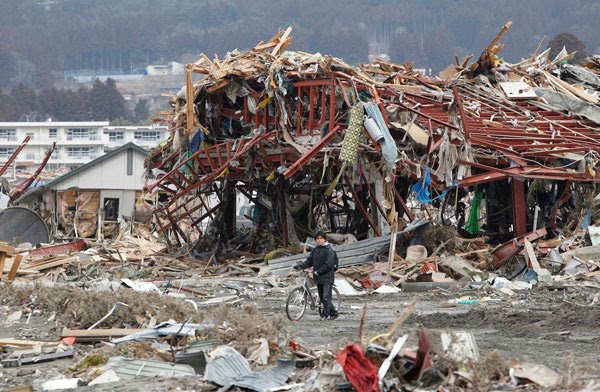
Once a pretty port set between the Yokote mountains and the Pacific Coast, Rikuzen-Takata effectively no longer exists. The town centre has been reduced to a vast field of flipped cars, mud-covered furniture and broken concrete. Only a few windowless buildings remain upright in the town centre, jutting up like tombstones from the field of death and destruction around them.
The death toll was still climbing Monday as rescue workers picked through the rubble with sticks, discovering new bodies so fast that they ran out of body bags and started carrying corpses on blankets taken from destroyed homes. Local officials estimated that between 20 and 40 per cent of the city’s predisaster population is dead.
“I think everybody in Takata town [the part of the city closest to the water] is dead,” said Matsumi Konno, a 54-year-old woman who was scanning a missing persons message board set up in a hilltop middle school that has been converted into a refuge for those who escaped the wreckage below. She was furious that her friends and neighbours had been herded into shelters so close to the coastline.
Mr. Kinno, the neighbourhood committee head, agreed that many had died because of poor preparation. Although he was outside Rikuzen-Takata when he felt the initial earthquake, he turned around and drove back into town when he heard the tsunami alarm.
When the 73-year-old arrived downtown, he was appalled to see so many people huddled inside the tiny community centre. “It was unintelligent,” he said, so he asked everyone to follow him to higher ground.
It was too late. As Mr. Kinno led a group of 60 people outside, he saw the wall of water coming for them. “It was black, black water. It was as if Godzilla had come and was trying to eat the people,” he recalled with awe in his voice.
Forty of those who followed Mr. Kinno into the streets were swept away in the rush of black. The rest scrambled into City Hall and raced the water up the stairs to the top floor, those moving too slowly drowning on their way up the stairs, Mr. Kinno said.
The water poured right through Rikuzen-Takata, and rushed past the mountains, filling the rice-growing valleys in between. The devastation carried five kilometres up the road into tiny mountain villages from where the ocean previously hadn’t been visible.
“We didn’t think this was possible,” said 52-year-old Iwako Onodera as she picked her way through the soggy and smashed remains of her family’s two-storey home, which now had a disconnected stretch of railway track and a flipped white Toyota van in the backyard. Though Ms. Onodera and her children were away when the wave struck, her parents died when water flooded the entire ground floor of the house.
Her brother Kaoru built the family home 10 years ago, but as he and Ms. Onodera salvaged whatever they could from the house, he said he didn’t expect to be back. “I don’t think people will want to move back here.”


And that is the saddest part. The home where I grew up was sold and remodeled; when I got the opportunity to return, some time after, it looked much the same on the outside. Standing inside, I did not recognize it. I stood stunned for minutes trying to get a sense of bearings I would never find. That is a fraction of what the survivors in dozens of Japanese cities and villages are going through. I wonder, if the government could wave a magic wand and remove the debris, rebuild the levees, the buildings, and the homes, how many would say, "This is no longer my home" and walk away as Kaoru Onodera plans.

My son KC notes that this disaster has brought out the "fire and brimstone" in many preachers.
I don't agree with either the "this is a judgement" or the "this is a sign of the end times" crowd. But what I will say is this. Being ready for the 8.2 quake (as the reactors were) but not the 9.0 that hit; being ready the ten-foot wave from 1960 and not the 50-foot one that came; the levee that could withstand the cat 3 hurricane and not the monster that was Katrina. New Orleans, Haiti, Chile, Pakistan, Christchurch, and now Sendai have shown us two things. Number one: safety measures on the cheap dictated by actuarial tables and short-term past history are no help when the planet itself is somehow becoming more violent. Number two: God's creation can break anything we build. If we follow the scientific data that protects us from the most disaster most economically, they fail and people die. If we build the safety measure to protect against a 10.0 earthquake and 100-foot tsunami, somehow we'll get hit with a meteorite which dwarfs our daydreams of destruction. The news media seems to think every disaster shows where we weren't prepared enough, we should have done more. At a certain point, we've got to just do the best we can and live with the consequences.

Thursday, March 17, 2011

Rikuzen Takata update #3

WAAAY too tired to really do this justice, but just got this article on reliefnet.com:

OBI delivers large quantity of rice to devastated Rikuzen Takata, Japan
Source:
Operation Blessing International
Date: 17 Mar 2011
Snow, Lack Of fuel, Impassable Roads Making Relief Efforts Difficult
RIKUZEN TAKATA, JAPAN (March 17, 2011) -- For the last two days the Operation Blessing International (OBI) disaster relief team has supplied food and water to over 1,500 people despite heavy snow, a lack of fuel, impassable roads, and the nuclear threat.
Yesterday the OBI team, under the direction of David Darg, director of international disaster relief, drove to the city of Oshu, where, thanks to the charity’s donors, they were able to purchase a large amount of rice at a supermarket. Darg had learned about the situation in Rikuzen Takata, a completely devastated area to the North that had only just been made accessible and was desperately low on food.
The team drove north through the mountains and a heavy snowstorm with whiteout conditions, only to arrive to a scene of total devastation unlike anything David Darg had seen before.
Darg said, “Since 2005, I have responded to dozens of major disasters around the world. In all my experience, I have never seen destruction like I saw in Rikuzen Takata today. Thousands of homes had been disintegrated into millions of fragments of wood. One three story building that must have been 70 feet tall gave clues to how high the Tsunami waters were; one resident told us that people taking refuge on the roof were standing in water up to their waists! The military had just bulldozed some of the roads clear, leaving walls of debris 25 feet high that we walked through like a maze. The debris was a mixture of wooden homes, household items and mud.
It is believed around 10,000 people were either killed or are still missing right here.”
OBI set up at one of 50 shelters, a school housing over 1,000 people, many of whom were sleeping in the auditorium. “The leadership at the shelter were so grateful when we told them we had rice. They are feeding the 1000 people in the shelter and 200 more who are without food. Up until now, the center had only been able to provide bread in very limited amounts and this was difficult, especially for the elderly who were very hungry.”
The rice that OBI provided should last the shelter one week.
On Tuesday, the team provided food and drinking water for 250 people who have set up a makeshift shelter in a school building in Shiogama, a city also decimated by the disaster.
Said Darg, “Families have moved into the classrooms and are sleeping on the floors on blankets. Outside, some of the families were burning wood in a metal can to keep warm; a sight that I’m told is very unusual for Japan where electricity and fuel networks are widespread. The food and water we had in the van was unloaded into the school kitchen and within 2 hours was being served to everyone in the shelter.”
Next, OBI is planning to distribute kerosene for the heaters in the shelters, as the temperature remains below freezing.


If you check out OBI's website (as I did), this story is fleshed out in a blog by Mr. Darg. He tells the story of one elderly gentleman who thought that his house had survived the inrush of the Tsunami, only to watch it float out to sea when it abated. He did manage to recover an Imperial Medal given him by former Prime Minister Yoshiro Mori some ten years ago.

I honestly have a hard time comprehending what it would be like standing on the ROOF of a 4-story building in WAIST-DEEP water, having to hang on to something, anything, for dear life and thinking, "THERE IS NO PLACE LEFT TO GO." I hope it never gets any clearer, for any of us.

Wednesday, March 16, 2011

Some seriousness, some fun

Before I heartlessy go on to the fun stuff, here's an article about the "myth of preparedness" from the Daily Yomiyuri:

RIKUZEN-TAKATA, Iwate--Tsunami caused by the massive Tohoku earthquake were so high they instantly breached the large embankments built along the Sanriku coastal region, local people said.
The region is equipped with highly advanced anti-tsunami measures constructed after previous disasters, including tsunami caused by the Great Chilean Earthquake in 1960 that killed 142 people in Japan.
One of the embankments in the region is even recorded in Guinness World Records.
After the tsunami left the region's towns covered in mud and debris from destroyed buildings, some survivors regret that too much confidence had been placed in the embankments.
"We all believed tsunami would never reach our area," said Ikuo Sugano, 61, who operates a futon shop in the Takatacho Omachi district in Rikuzen-Takata.
The area has been hit by many tsunami following earthquakes, including the Meiji-Sanriku quake in 1896, Showa Sanriku quake in 1933 and 1960 Chilean quake.
However, the Omachi area, which is about a kilometer from the coast, was not affected by the Chilean quake. As a result, local residents believed tsunami would never reach the area.
When they held a study session to prepare for powerful earthquakes and tsunami two months ago, they only discussed accepting survivors from other areas and preparing meals for them.
They never imagined they would be tsunami victims themselves.
"I remember the time [of the tsunami caused by the Chilean quake], but I never thought a stronger tsunami was possible," Sugano said. "I was much too optimistic."
In the Tohoku quake, a 10-meter wave of water poured into the Omachi area and instantly smashed shops and houses to matchwood.
Although there is some high ground north of the area, very few local residents headed toward it to reach safety.
Nearly 60 percent of people belonging to the area's neighborhood association are still missing.
"All of us thought the tsunami would never reach our places. But we were wrong," said a 63-year-old man who lives in an area about one kilometer inland from the Omachi area. His house was destroyed in the tsunami.
"Our embankment is the best in the world. How come we suffered that much?" asked a resident in Kamaishi, Iwate Prefecture, as he looked with dismay at what was left of the embankment.
===
Recorded in Guinness book
The 1,960-meter-long embankment was built at a cost of 130 billion yen over a 30-year period from 1978.
It was the nation's first embankment designed to resist the most powerful earthquake. Its foundation was built on the seabed 63 meters below the surface of the sea. It was recorded in Guinness World Records as the embankment that is the world's deepest in water.
When a major quake hit Chile in February last year, the Land, Infrastructure, Transport and Tourism Ministry's Tohoku Regional Bureau proudly announced that the embankment helped keep back the tsunami that reached the area.
"Some people had built new houses near the coast because they were so confident in the embankment," the Kamaishi resident said with a sigh as he stood in front of the debris of destroyed houses.
===
No match for raging torrent
In Ofunato, Iwate Prefecture, many people were killed in the tsunami caused by 1960 Chilean quake.
As a result, a large embankment was built at the mouth of the Ofunato Bay.
According to the city's port and business department, the tsunami destroyed most of the 291-meter-long southern part of the embankment and all of the 243.7-meter-long northern part.
Although local residents saw the embankment as a visual symbol of the city's invulnerability against tsunami, it had weakened over time.
"We were almost sure we could start strengthening it with funds from next fiscal year's budget," a city employee in charge of disaster prevention said.
In the city's Sanrikucho Okirai area, 19 people were killed in the 1933 Showa Sanriku quake and ensuing tsunami.
Shinsaku Katayama, 85, a survivor of that tsunami who works in the construction business and lives in the area, has given lectures at primary and middle schools to increase teachers' and students' awareness of the danger of tsunami, using notes of the 1933 disaster he compiled over a one-year period.
Katayama said the number of participants in local disaster drills had fallen over the past few years and he felt awareness of the danger of tsunami had declined.
"Because of the embankments, they never imagined they'd be hit by tsunami. They acted as if nothing untoward would happen," he said with an air of despair
.

I didn't highlight certain passages to dig a knife into their backs. I did it to remind us, the world is the Titanic. No matter what we feel we are prepared for, there is always something out there waiting to overwhelm it. That is why I feel so sad for our atheist brethren- this kind of thing is Exactly why we need faith in a Loving and Merciful God. Without Him, losing everything would mean... losing everything.

_____________________________________________________________

Okay, now let's have a little fun with this week's crop of e-mail scammers. Our first contestant showed up Tuesday:
SCAM VICTIM REIMBURSEMENT.
We wish to bring to your notice as a delegate from the Nigeria Government Reimbursement committee under the strict supervision of the United Nations to pay 230 Nigerian 419 scam victims the sum of $7,500.000.00 (Seven Million Five Hundred United states Dollars) each. You are hereby listed as one of the beneficiaries for this immediate reimbursement of funds.As a result of this laudable recommendations,it is imperative to bring to your notice that during the last U.N. meeting held in Abuja, Nigeria,it was alarmed by so many countries around the world about loss of funds by various foreigners to these scam artists operating in syndicates all over the world today.
In other to redeem the good image of our dear country,the President has ordered the immediate payment of $7,500.000.00 (Seven Million Five Hundred United states Dollars) each to the affected victims in accordance with the U.N. directives.Due to the corrupt and inefficient Banking Systems in Nigeria, these payments are to be made by ECO BANK OF NIGERIA as the corresponding paying bank under the funding assistance of the INTERNATIONAL MONETARY FUND(WORLD BANK) Presently, 184 Beneficiaries have been paid, more than 50% of the victims are from the United States,while about 40% are from other parts of the world.Your particulars were among those mentioned by some of the Syndicates hat were apprehended in Lagos, Nigeria as one of the victims of the operations, you are hereby warned not to communicate or duplicate this message to anybody for any reason whatsoever as the U.S. secret service in conjunction with The Economic and Financial Crimes Commission (EFCC) has swung into action to track these set of criminals down.Once again,you are expected to keep away until these criminals are all apprehended.The Economic and Financial Crimes Commission (EFCC) (Motto: No Body is Above the Law) have combined effort with the United Nations Anti-crime commission to alleviate the plight of these victims as well as redeeming the image of our dear country.
Many Banks, Universal firms, Companies and individuals have been in bankruptcy today due to the activity of these hoodlums. However, a thorough investigation revealed that these people have dropped over 500,000 victims across the world, after collecting their money falsely, many as a result of this have committed suicide,while others are now living in abject poverty.As regards these on going developmental strive, we have over 200 suspects at hand, 135 in kirikri prisons.While many are awaiting trial, we are still in search of others,who think they are wise, and hope that you will assist by giving any vital information that could lead to the apprehension of these hoodlums.
You SHALL receive your reimbursement via TRANSFER PAYMENT SYSTEM. We shall be waiting to hearing from you for the final claim of your $7,500.000.00 (Seven Million Five Hundred United states Dollars) Reimbursement fund.Finally, you are urgently advised to furnish this office with your full names/address, your direct phone/fax number, your age/marital status and an attach copy of any of your recent Identity.Awaiting for your prompt response.
Yours faithfully,
DR.ASHINZE AUSTIN
FRAUD VICTIMS REIMBURSEMENT CHAIRMAN.
TEL:+234-812-286-4272

Okay, so let's look this over. First, do you really think any president from any country would establish a scam-payback fund out of wanting to "redeem the name of this dear country"? Okay, we could all see Obama doing it, and there may well be chief execs out there who are even dum... er, more politically correct than Barrack. Second, "Due to the corrupt and inefficient Banking Systems in Nigeria, these payments are to be made by ECO BANK OF NIGERIA as the corresponding paying bank". So, since the Nigerian system is so corrupt, let's pay things out through a Nigerian bank. Good thinking there! Third, What does the Secret Service have to do with investigating financial crimes. Fourth, interesting that I was on the "dumbass got scammed list" when I haven't yet get quite that stupid yet. Maybe they're looking for that other CW Martin who still lives in New Haven. Fifth, while there is an apparently legit EFFC, I was not able to find any link to "corny mottos" on their site. Sixth, I think you mean that they have "duped" 500 k people around the world, not "dropped", unless they combine their monetary services with a travel agency. Finally, "As regards these on going developmental strive". WTF does THAT mean? Other than if these people are really involved with the UN, they might want to cross-ref with UNESCO and learn proper grammar. That sentence came straight out of one of my son's 6th grade essay assignments.

This next one actually tried to weave a little more reality into the BS.
Atten Dear Sir/Madam
This message is permitted to be read only by the beneficiary of this address for security purposes? We have been having meetings for over (5) Five Month and we have come to the final conclusion from our last meeting held at our headquarter February 28th, 2011 with the president of Benin Republic Dr. Thomas Yayi Boni and Minister of Foreign Affairs Mrs. Mariam Aladji.
The United Nations Office have agreed to compensate you with the sum of $1.500,000.00USD and that is why we decided to contact you directly and make sure that this information reached you, This funds have been arranged for you through our ATM Swift Card Payment Center Diamond Bank Plc as that is the latest instruction by His Excellency Mr. Ban Ki-Moon The Secretary-General The United Nations.
This compensation includes every foreign contractors that may have not received their contract fund and people that have had an unfinished transaction or international businesses that failed due to Government problems etc?
You are advised to contact our representative Mr. Jim Wilfred of Diamond Bank PLC Benin Republic and Send to him your full contact details as follow: (1) Full names….: (2) Country:...... (3)Address:...... (4)City:........ (5)Tel Phone: (6) Occupation :......(7)Age:... (8): Sex.....
Contact Mr. Jim Wilfred With the Below Information:
Contact Person Mr. Jim Wilfred
Director Diamond Bank Plc
Benin Republic
Email: (infoatmcustomercare@globomail.com )
Phone: +229-9917-2795
Click on this link to see by yourself (http://www.un.org/News/Press/docs/2003/ik344.doc.htm)
Making the world a better place
Regards,
Ms. Asha-Rose Migiro

Okay, so there is a President Thomas Yayi Boni in Benin, and Ms. Migiro is a deputy to Ban Ki-Moon. And, despite my doubts, "His Excellency IS the proper way to address a UN Sec-Gen. There is even a Diamond Bank PLC , although it is in NIGERIA (obviously a part of that corrupt Nigerian banking system), not Benin. Also, we see two question marks, both of them where they do not belong. Another glitch in the google Yoruba to English program, no doubt. Also, and this is a tip to you would be victims out there- Are you a contractor whose done business in Benin? Or a business person with dealings in Benin? I'M NOT! And nobody seems to know who Jim Wilford is, except the scam sites that have various examples of his handiwork.

Finally, Punctuation? We don' need no Steenkin' punctuation!

Christopher the economy is not the same as it used to be the internet is where you make the most money now we will be more well off now than ever before you wont regret giving this program a shot you dont need experience to use this program http://j.mp/dZBO3j there is no limited to your boundaries

Okay, let's all take a breath and look at this. First of all, I have a PSA for my wonderful readers _ let's not be stupid and click on any of these links, okay? I'm quite confident that they are full of ooze that will choke off all the love and kindness that resides in your computer. Second, if the internet was the place to make money we'd all be rich, eh? Third, "there is no LIMITED to your boundaries." (Oops, shouldn't have put that period in there.) Again, welcome to the KC Martin School of Grammar circa 1990.

Tuesday, March 15, 2011

Rikuzen Takata update #2

At this point we have an abundance of pictures from the city, showing what it looks like now. Before we go there, a fellow blogger posted pictures of her time there in the spring of 2006. You can see them at http://fightswithivy.wordpress.com/2011/03/13/memories-of-miyagi/. Another person commented on my last update and gives a link to more devastation, including a look at a still standing school they used to teach at. Other pictures can be seen at http://news.xinhuanet.com/english2010/photo/2011-03/15/c_13779776.htm. Here are another couple I found.


The wide-angle view.

The scale of the disaster.


Yasunobu Sasaki is the school principal who is now basically in charge of the school-turned-shelter. He says, "The people are exhausted both physically and mentally." He says they can do nothing but shivver under blankets due to the hypothermia and low temperatures, and he cannot find enough food to give them the 3 meals a day they need to recover. Reporter Mark Mackinnon of Canada's Globe and Mail tweeted that he was told that 40% of the pre-quake population of the town is likely dead. That would be 9,200 to 9,800 in just this town.

I don't mean to make it appear that this is the only place people are suffering. The town of Minamsanriku has 1,000 confirmed dead and 8,000 still unaccounted for. In Otsuchi, 12,000 out of a population of 15,000 are missing. And it goes on.

Sunday, March 13, 2011

Rikuzen Takata update

I've been combing the reports for info on the Town I decided to feature in the Japan tragedy, Rikuzen-Takata. One report said that only 5,900 of a population of over 23,000 had managed to find shelter before the tsunami hit. Police said Saturday morning that they had dug up 300-400 bodies already from the debris. Rikuzen-Takata, described by the Daily Yomiyuri online as one of six nearby communities whose "administrative functions are paralyzed" (no surprise since the wave reached to the third floor of the city hall), was flown over Saturday morning by Yomiyuri reporter Koji Yasuda, who gave this report:

" The next town south was Rikuzen-Takata, but almost no buildings were to be seen where the town should have been located. It seemed as if the port town had suddenly vanished. What I could see there were only medium-rise buildings believed to be made of reinforced concrete, such as a hospital."

Reading about it only gives a vague idea. Here's video from the town.


In the meantime I found this report, orignally in German, on the fate of the Asia League and the Anyang Halla team.

Asia earthquake prevented League final
Saturday 12 March 2011, 18:32
- Martin Merk
The severe earthquake in Japan left over 1000 dead and hockey not spared. The final series of the Asian league, which would have to start yesterday, was canceled until further notice. The two teams had this blessing in disguise, because they were both on the hard-hit east coast in Fukushima Prefecture. The home team, the Tohoku Free Blades trained in its ice rink in Koriyama, Japan when the earthquake struck. The players immediately rushed from the ice to shake as the earth and pieces of concrete started falling off. The crew spent the night in an office building because their hotel was damaged.
Even the visiting team, the defending champion Anyang Halla in South Korea, had a blessing in disguise. It was only just landed in Sendai and on the way to Koriyama, when the earthquake began. The team is now in Fukushima, and only a short time before there was an explosion at a nuclear power plant took place, took off and returned to South Korea. When the playoffs will continue is as yet unclear and especially for the Japanese probably currently not in the foreground.

Sounds like the Korean team dodged several bullets. I'll keep checking the updates on this, but let me go around to the league's Japanese cities and see how they fared.
Nikko (home of the Ice Bucks)- found nothing. No news is good news, eh?
Kushiro (home of the Nippon Paper Cranes)- in the north of Hokkaido, away from the damage.
Tomokomai(home of the Oji Eagles)- on the south shore of Hokkaido, some minimal damage to docks.
Hachinhoe (one of two home bases for the Tohoku Free Blades)- whole areas flooded, lots of ships washed ashore, including a fishing boat thought lost in the wave, from which 81 survivors were choppered out.
Koriyama (their other home)- plenty of damage, but standing enough that the FoxNews stringers moved there when the radiation evacs began.

That's the news for now. I'll keep following news from Rikuzen-Takata for a while.

Saturday, March 12, 2011

Japan update

The Indiana attorney-general asks you to check out charities to give donations for Japan through www.CharityNavigator.org . This site gives ratings and charity by charity info. We chose AmeriCares, which was higher rated and gives more right to the project than Red Cross. Only drawback id the donation is collected through NetworkForGood, which charges a fee that can come off the top of your donation of get added on.

And don't forget, God doesn't charge a fee for prayer.